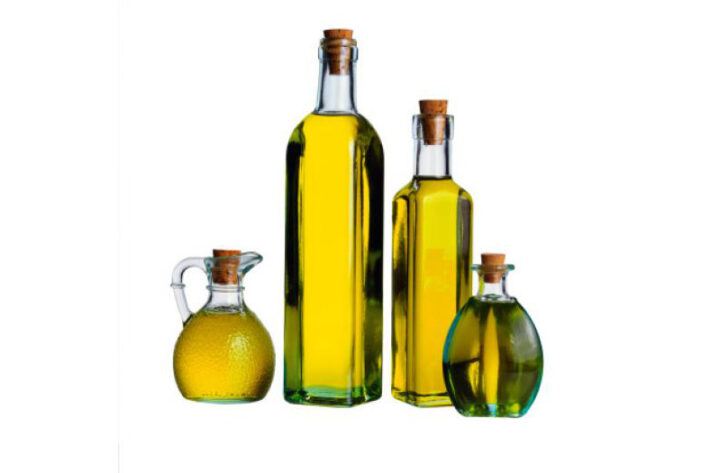
Category - Fluid, foaming & viscous liquid

Edible oil filling machine

  Why does edible oil filling present specific constraints? Edible oils are fluid to semi-viscous liquids, but their characteristics vary significantly depending on origin, formulation, and temperature. A manufacturer filling several oil references faces very different behaviours on the same line. The greasy and wetting nature of oils Oils spread across every surface they touch. …
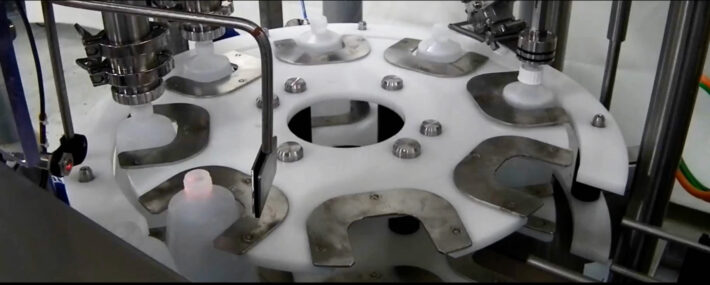
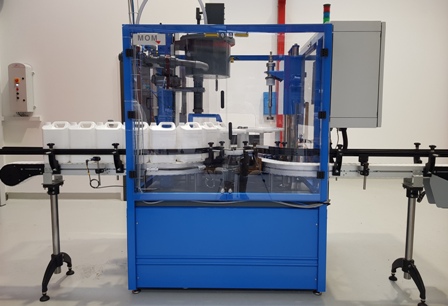
Continuous vs intermittent rotary filling: which solution should you choose?

Why compare continuous rotary and intermittent rotary filling? The choice between a continuous rotary system and an intermittent rotary system is not only about production speed. It directly impacts line design, mechanical complexity, the number of possible formats, changeover times, machine footprint, and filling stability. In a filling line, this choice must take several criteria …

Corrosive product filling machine

Why Does Filling Corrosive Products Involve Specific Constraints? Corrosive products have one major characteristic: they can attack materials in contact with the product. Usually, some aggressive chemical liquids gradually degrade metals, seals, or specific technical components of the filling machine. In this context, a standard stainless steel design is not always sufficient. In other words, …

Technical glossary of industrial liquid filling

Contents ATEX Ball valve nozzle CIP / Clean-in-place Corrosive / Chlorinated Diving nozzle Dosing cleanliness Flap nozzle Fluid / Free-flowing Foaming Gravity dosing Hygroscopic IPFA Legal metrology Liquid with particles Mechanical piston Net constant-level filling Pneumatic piston Spout nozzle Viscosity Volumetric dosing Weight-based dosing   ATEX An ATEX zone is an area in which an …

Complete guide to industrial liquid filling

How to use this guide Understanding liquid behaviour Identifying the right dosing technology Choosing the right filling nozzle Understanding constraints and specific requirements Validating choices through trials   Technical guides by liquid type Filling foaming products Filling viscous products Filling liquid chlorinated products Filling detergents   1. Understanding liquid behaviour The different characteristics of liquids …

Liquid filling: gravity gravimetric vs volumetric piston: which solution should you choose?

Why compare gravity gravimetric filling and volumetric piston filling? The choice between a gravity gravimetric filling system and a volumetric piston filler is not only about accuracy. It also impacts machine design, compatible product types, cleanability, achievable production rates, and line flexibility. These two technologies follow different operating principles. Gravity gravimetric filling measures the actual …

Windshield cleaner filling machine

Why does windshield washer fluid filling involve specific constraints? Windshield washer fluid belongs to the category of foaming products. In practice, the behavior of the liquid depends heavily on its formulation, packaging, and filling conditions. If the machine does not properly control the dosing process, several issues can quickly arise: foam overflow container contamination reduced …

Hydroalcoholic Gel Filling Machine

Why does hydroalcoholic gel filling involve specific constraints? Hydroalcoholic gel is a specific liquid product that requires particular filling conditions. Alcohols are flammable or highly flammable. Among the most commonly used alcohols, the flash point can range up to 40°C (and sometimes 12°C). Alcohol vapors can form explosive mixtures with air. Another important constraint is …

Filling liquid chlorine products

Otherwise, machines for filling liquid chlorine products should have the same advantages as other equipment: Simplicity of size changes (fast and without tools), Nozzles adapted to the products (especially nozzle trays for foaming products), The possibility to use the equipment for non-chlorinated products. PVC filling machines by MOM MOM designs and manufactures high speed automatic …

ATEX liquid filling machines

Depending on the products and packaging, the spheres must then be calculated. The formulas for calculating the spheres can also be found in the EN60079-10 standard. Calculating spheres does not prevent common sense. In the case of light gases (less dense than air) a cone-shaped ceiling with a suction at the highest point should be …

Detergent filling machine

Why does detergent filling present specific constraints? Detergents are a highly heterogeneous product family. A single manufacturer may need to fill products with very different behaviours: fluid foaming washing-up liquid, semi-viscous laundry detergent, corrosive multi-surface cleaner, viscous toilet gel. Each product places different demands on the filling machine. A very wide viscosity range Depending on …

Filling of viscous product

Flap valves for fluid to semi-viscous liquids In the case of fluid and slightly viscous liquids, manufacturers use so-called poppet nozzles. Flap valves are divided into several categories. The “simple” flap valves are valves which are sealed by simply lowering the flap into the valve seat. The advantage of the simple valve is the absence …

Foaming liquid filling

Plunge cane spouts Historically, the first solution found to avoid foam was to fill bottles from the bottom. The spout enters the packaging, then comes out as it is filled. This method solves foaming problems in most cases. However, plunge rod spouts have many drawbacks. The first is a drop in rates: the nozzle must …

High speed filling machine

Choosing a high speed filling machine A high speed filling machine is designed to fill thousands of packagings per hour. It should reach this speed whilst maintaining its accuracy and cleanliness, and eventually following specific constraints such as ATEX, dust, acids or bases,… In this article, we will answer the following questions: How does such …

Piston dosing : mechanical or pneumatic ?

Piston dosing to fill fluid and viscous liquids Piston dosing is a volumetric dosing technology that is particularly efficient to fill viscous and pasty liquids (such as honey, glue, cream, etc). When classic gravity flow is not enough for your product, it is necessary to “push” it in its container. That is the piston’s role. …

+33(0)1.48.60.11.70

contact@mom-packaging.com

19 Allée Louis Breguet - 93421 Villepinte

    I would like to


    Packaging

    Bags, PouchesBottles, cans, box

    Products


    FluidSemi-viscousViscous

    PowdersGrainsFragments

    Speed

    Equipment

    FillerClosingComplete lineDoserSmall-lineIntegrated lineMonoblocLinearAdditional equipment

    My details (* mandatory fields)


    +33(0)1.48.60.11.70

    contact@mom-packaging.com

    19 Allée Louis Breguet - 93421 Villepinte